
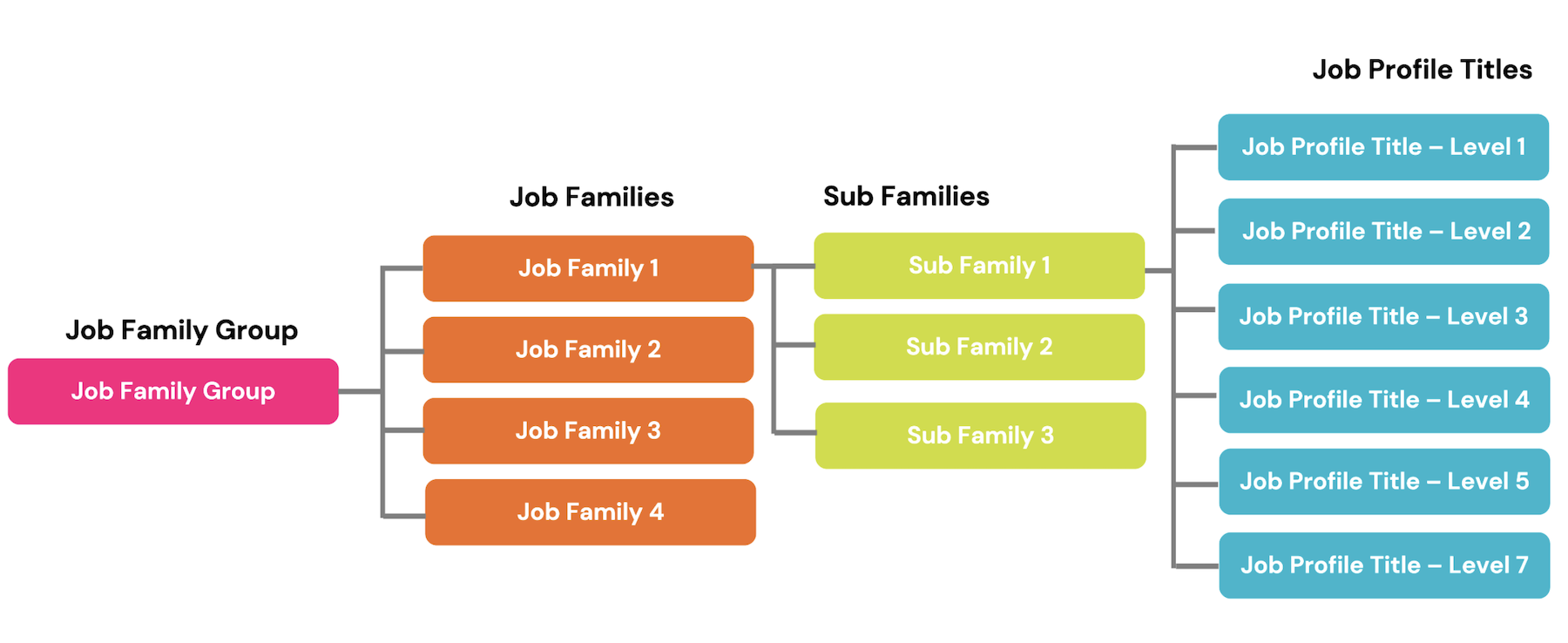
A job family is a group of roles that share a common purpose, focus and core capabilities.
Roles within a family have similar types of work, require related skills and knowledge and often follow a consistent career path.
For example, “Finance”, “HR”, “Data and Analytics” or “Engineering” might each be a job family, with levels or sub-families reflecting progression – from entry-level to leadership roles.
Job families make it easier to align, evaluate and grow roles across your organisation.
In many organisations, job data is chaotic, inconsistent and unstructured with little governance or ownership.
Job titles often evolve organically as organisations grow, merge or restructure. Even when a job framework exists, it can quickly drift from its original design, becoming fragmented and hard to maintain.
The result = Job chaos.
Organisations often find themselves with:
Introducing job families changes this picture completely.
With a well-structured job family framework, organisations can:
Implementing job families turns confusion into clarity — providing the structure and stability needed to make fairer, smarter decisions and build a stronger employee experience.
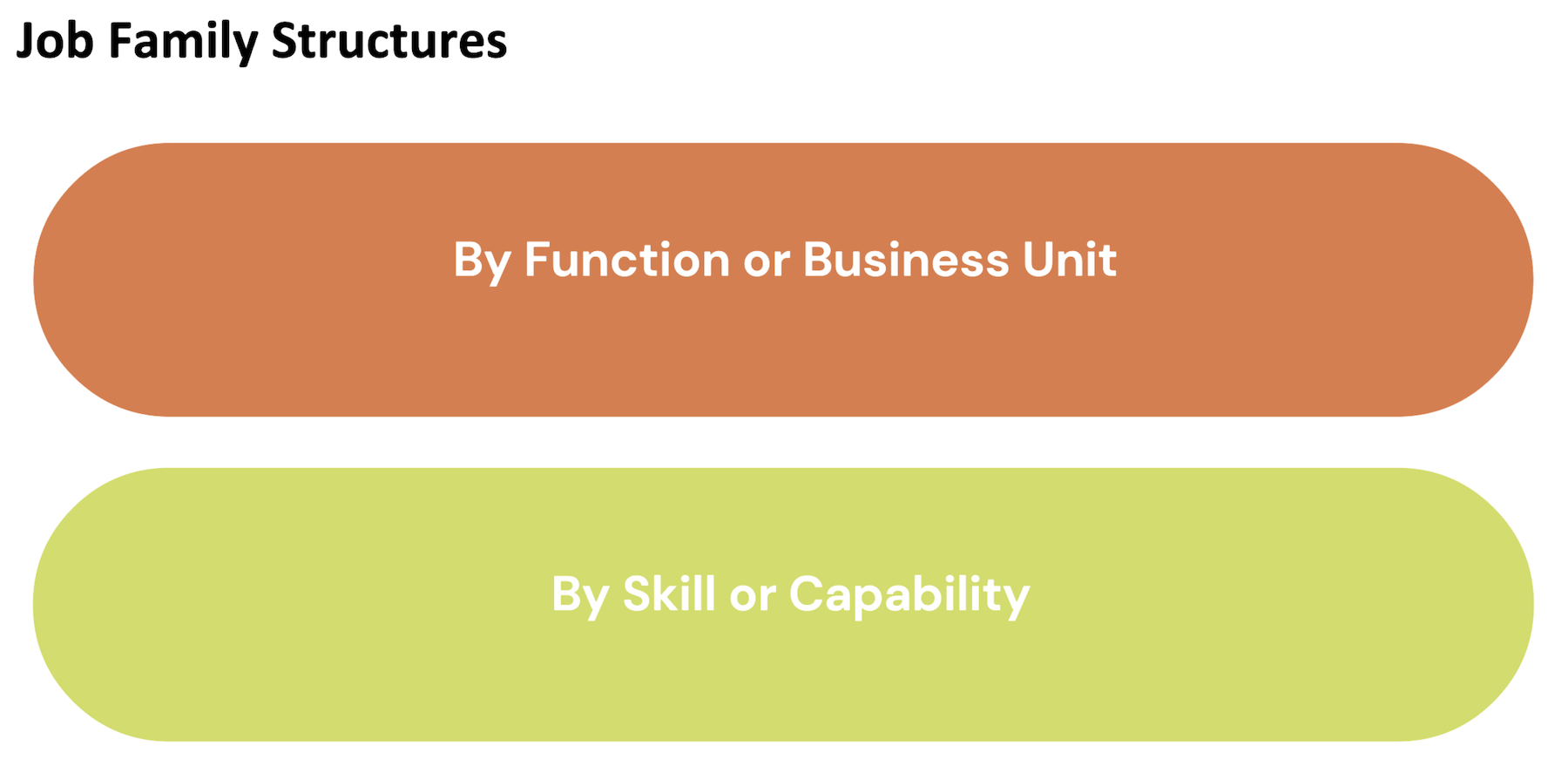
There are two main ways of designing job families, depending on your organisational needs and objectives:
1. By Function or Business Unit
This approach involves creating job families based on existing organisational functions such as HR, Finance or by business unit such as Engineering or Customer Service.
It reflects how work is organised today and can make implementation easier in larger, functionally structured organisations.
2. By Skill or Capability
This approach creates job families based on shared skills or capabilities — such as Project Management, Data Science or Innovation.
It supports skills-based strategies and enables greater workforce flexibility, allowing learning solutions, career paths and mobility to extend across functions.
Book a demo to learn more about how RoleMapper can help clean up & harmonise your job architecture & job descriptions.

A data-driven view of work to power automation and optimisation.
By structuring and analysing roles through job families, organisations gain a clearer view of work patterns and activities. This insight enables data-led decisions about where AI and automation can streamline workflows and improve efficiency.
Understand your workforce capabilities.
By defining skills and proficiency requirements across families and levels, job families provide the foundation for skills-based talent strategies, helping you identify gaps, redeploy skills and plan for the future.
Clear expectations mean better performance.
Job families define the skills and competencies required at each level, enabling objective assessment, fairer progression and stronger development planning.
Clarity creates opportunity.
Job families show how roles connect, outlining what’s needed to progress within or across families. This transparency helps employees see career paths clearly and enables managers to support development with confidence.
Consistency drives confidence in pay.
Job families provide a single structure for job levels and pay bands, removing subjectivity from pay decisions and enabling alignment with external market benchmarks.
Creating job families can seem complex, but with the right process it becomes structured and scalable.
Here’s how RoleMapper helps clients approach it:
Explore our 5 Steps to Building Job Families Guide for detailed insights and practical advice on how to structure and embed job families in your organisation.
RoleMapper is an AI-powered job description management solution.
Our proprietary AI and advanced Natural Language Processing can transform your existing job titles and job data into a robust, future-focused job architecture, job family framework and job titling framework.
Our platform eliminates the cost and time burden on Reward and HR teams when creating a job architecture and job family framework to review within the business, while providing an accurate representation of your organisation for strategic business and people initiatives.
As part of RoleMapper’s AI-enabled service offerings, our in-house subject matter experts can transform your organisation’s job data into a modern, standardised and fit-for-purpose job family framework.
Using RoleMapper’s AI, our team of experts will:
Want to understand more about job families and their impact on organisational structure and fairness? RoleMapper offers practical resources and expert insights to help you get started.



Role Mapper Technologies Ltd
Kings Wharf, Exeter
United Kingdom
© 2026 RoleMapper. All rights reserved.