

Talk to our team
Speak to a specialist about a guided engagement for your organisation.
Talk to our teamSee how it worksFrom the hub
Guides, webinars and research to help you build better job architecture
Browse all resourcesSubscribe for updatesSpeak to a specialist about a guided engagement for your organisation.
Talk to our teamSee how it worksGuides, webinars and research to help you build better job architecture
Browse all resourcesSubscribe for updatesA comprehensive guide to the platforms and consultancies helping organisations build consistent, transparent and defensible job levelling and evaluation frameworks in 2026.
RoleMapper is an AI-powered platform that transforms the way organisations approach job architecture and job levelling, replacing fragmented, manual processes with a connected, governed and future-ready system. Its job levelling and evaluation capability is delivered through RoleEvaluate, the first purpose-built job levelling and evaluation platform designed for a pay transparency world.
The core insight behind RoleEvaluate is that every existing solution forces a trade-off. Consulting-led systems are defensible but impractical at scale and locked behind consultant dependency. Lightweight tools are accessible but lack the rigour to withstand regulatory scrutiny. In-house frameworks rely on one person's judgement and have no audit trail. RoleEvaluate is the first product designed to deliver both defensibility and scalability at the exact moment when pay transparency legislation makes both non-negotiable.
RoleEvaluate combines the simplicity and transparency of a levelling framework with the robustness and defensibility of a point-factor methodology. The evaluation methodology, informed by established job evaluation practice, work design principles and equal pay case law, is embedded directly into the scoring workflow. All four EU Pay Transparency Directive Article 4 mandatory dimensions (skills, effort, responsibility and working conditions) are captured in the scoring model. Evaluators receive real-time decision support and comparable role context at the point of scoring, with every decision captured in a full, accessible audit trail. It integrates seamlessly into RoleMapper's Job Architecture Workspace and Job Profile Management modules, providing end-to-end management, governance and controls in a single connected environment.
Key features:
The only solution built for compliance from day one - Every other methodology in this market predates the EU Pay Transparency Directive. RoleEvaluate was designed from the ground up against EUPTD Article 4 requirements and established equal pay principles. All four mandatory evaluation dimensions are built into the scoring model. The audit trail, governance workflow and transparent scoring logic are not features added to meet compliance — they are the architecture of the product.
Methodology embedded in the workflow, not locked in a specialist’s head - Traditional schemes require deep evaluator expertise because the methodology is not embedded in the platform. RoleEvaluate puts the methodology in the system: evaluators are guided through each decision with decision support, comparable role context and sub-factor descriptors, rather than having to hold a complex framework in memory. This is what makes consistent, scalable evaluation possible without ongoing specialist dependency.
A complete and accessible audit trail, no black box - Scoring logic is fully transparent: parent factors, sub-factors, with available weights and scoring logic visible on demand. Every evaluation decision captures sub-factor level scores, free-text justification, calculated points, band placement and any panel review notes. The audit trail is the defensibility chain and it is accessible to the client, not held by a consultant.
In-platform calibration with comparable role context - Evaluators can see where comparable roles have landed across job families and career tracks, providing a live calibration reference before a decision is confirmed. This removes the reliance on retrospective calibration workshops and ensures consistency is built into the process rather than corrected after the fact.
Dual-method approach that scales across the organisation - Organisations rarely need to run full point-factor evaluation on every role. RoleEvaluate supports full sub-factor evaluation for anchor and benchmark roles and structured classification for the remainder with the platform showing how classified roles compare against fully evaluated anchors at the same level. Governance workflows, panel review and user permissions manage who can evaluate, classify and confirm, ensuring central oversight while distributing the operational workload.
Bias-aware by design - Sub-factor weighting principles are specifically designed to prevent the systematic over-rewarding of management track roles relative to senior individual contributorsand to weight influence without authority higher than collaboration capturing the differentiating value of matrix leadership. This is not a retrospective check; it is built into the scoring architecture. This includes capturing influence without authority as a distinct sub-factor, recognising the matrixed, networked reality of modern enterprise work that legacy schemes routinely under-weight.
AI that assists rather than replaces human judgement - RoleEvaluate uses AI to surface relevant content and guide sub-factor decisions but keeps human judgement at the centre of every evaluation decision. This is a deliberate design choice: AI assists the evaluator rather than replacing the decision, ensuring consistency, auditability and human accountability at every step.
End-to-end integration across job architecture and levelling - RoleEvaluate connects directly into RoleMapper's Job Architecture Workspace and Job Profile Management modules. Levelling outcomes connect to role profiles, skills and pay bands. Connected data across all elements of job architecture enables interrogation across all data points — skills to factors, roles to levels, levels to pay — without toggling between disconnected systems.
Designed to work with existing frameworks - RoleEvaluate is built to complement rather than replace existing levelling investments, reducing the overhead of transition for organisations moving from established frameworks.
Purpose-built innovation in a market defined by legacy approaches - Most evaluation tools in this market are built on methodologies and technology that have changed little in decades. RoleEvaluate has been designed from the ground up for how organisations work today and for what regulators now require. For organisations that have struggled to make traditional systems work at scale, or that are facing pay transparency obligations for the first time, this distinction matters.
RoleMapper Cons
Best suited to organisations seeking an integrated approach - RoleMapper's full value is realised when levelling is connected to the broader job architecture and role profile management platform. Organisations looking for a standalone evaluation tool with no intent to manage job architecture systematically may find the integrated model more than they currently need.
Designed for mid-to-large organisations - RoleMapper is built for enterprise and mid-market environments where the scale, governance requirements and pay transparency obligations justify the platform's depth. Organisations with fewer than 100 employees may find it more extensive than their current requirements demand.
Mercer is a global consultancy providing a wide range of HR and reward services. Its approach to job evaluation centres on the Mercer International Position Evaluation system (IPE), assessing roles across four core factors (impact, communication, innovation and knowledge), with risk available as an optional factor where relevant.
Mercer typically works with organisations on a project basis to design and implement a job evaluation framework using IPE, supported by its Job Architecture Tool (JAT) — a web-based platform for storing and managing the resulting structure. The process is consulting-led, with Mercer's specialists guiding the implementation and the tool used primarily to manage outputs and maintain the framework after delivery.
Key features
Established methodology with strong market credibility - Mercer IPE is a globally recognised job evaluation framework. Its adoption across large, complex organisations carries weight with senior stakeholders, which can ease the internal approval process, but recognition alone does not address the practical challenges of applying the methodology consistently in-house.
Strong alignment with compensation benchmarking - Because Mercer's salary surveys are aligned to IPE grades, organisations using both benefit from direct comparability between internal evaluation outcomes and external market data, reducing the gap between job sizing and pay benchmarking.
Centralised management of evaluation outputs - The JAT provides a single location to store and manage job architecture and evaluation data, improving visibility and supporting consistent application across teams and regions.
Mercer IPE cons
Methodology complexity creates ongoing dependency - IPE is a sophisticated methodology that is not straightforward to learn or apply consistently without expert guidance. Mercer offers paid training to support users, but the complexity means organisations often remain dependent on Mercer's consultants for ongoing evaluation work, adding cost and reducing agility. For many organisations, the methodology never truly moves in-house.
The JAT is a storage tool, not an evaluation platform - This is an important distinction. The Job Architecture Tool stores and displays job evaluation outputs, it is not an evaluation workflow engine. Organisations cannot conduct, govern or audit evaluation decisions within the platform itself, which means the process of evaluation remains manual and consultant-dependent regardless of the tool in place.
Consulting-led model limits self-serve governance - The approach is built around a defined project implementation rather than continuous in-platform management. Once the initial project concludes, ongoing updates, recalibrations and governance depend on re-engaging Mercer rather than managing the framework independently, a recurring cost and a recurring delay.
Premium pricing with high total cost of ownership - Mercer's fees and focus on large global organisations are reflected in its pricing. The combination of implementation fees, paid training and ongoing consultant dependency for updates and recalibration means the total cost of ownership is typically significantly higher than dedicated software platforms often without a clearer outcome.
Framework-led design constrains flexibility - IPE is built around Mercer's established methodology and job library, which shapes how roles and levels are structured from the outset. Organisations with bespoke structures or rapidly evolving ways of working may find the framework pulls their design in a direction that does not fully reflect their organisation.
Korn Ferry is a global consultancy supporting organisations with talent strategy, organisational design and workforce transformation. Its job evaluation offering is delivered through Korn Ferry Architect, a module within the Korn Ferry Intelligence Cloud, using the Korn Ferry / Hay methodology, one of the oldest and most widely recognised point-factor evaluation frameworks in the world.
The Hay methodology assesses roles across three core factors: know-how (knowledge), problem-solving and accountability. Working conditions is an optional contextual factor. Korn Ferry Architect automates the application of this methodology to evaluate roles and design a job architecture and levelling framework, which can then be connected to career frameworks and pay structures within the broader Intelligence Cloud.
Key features
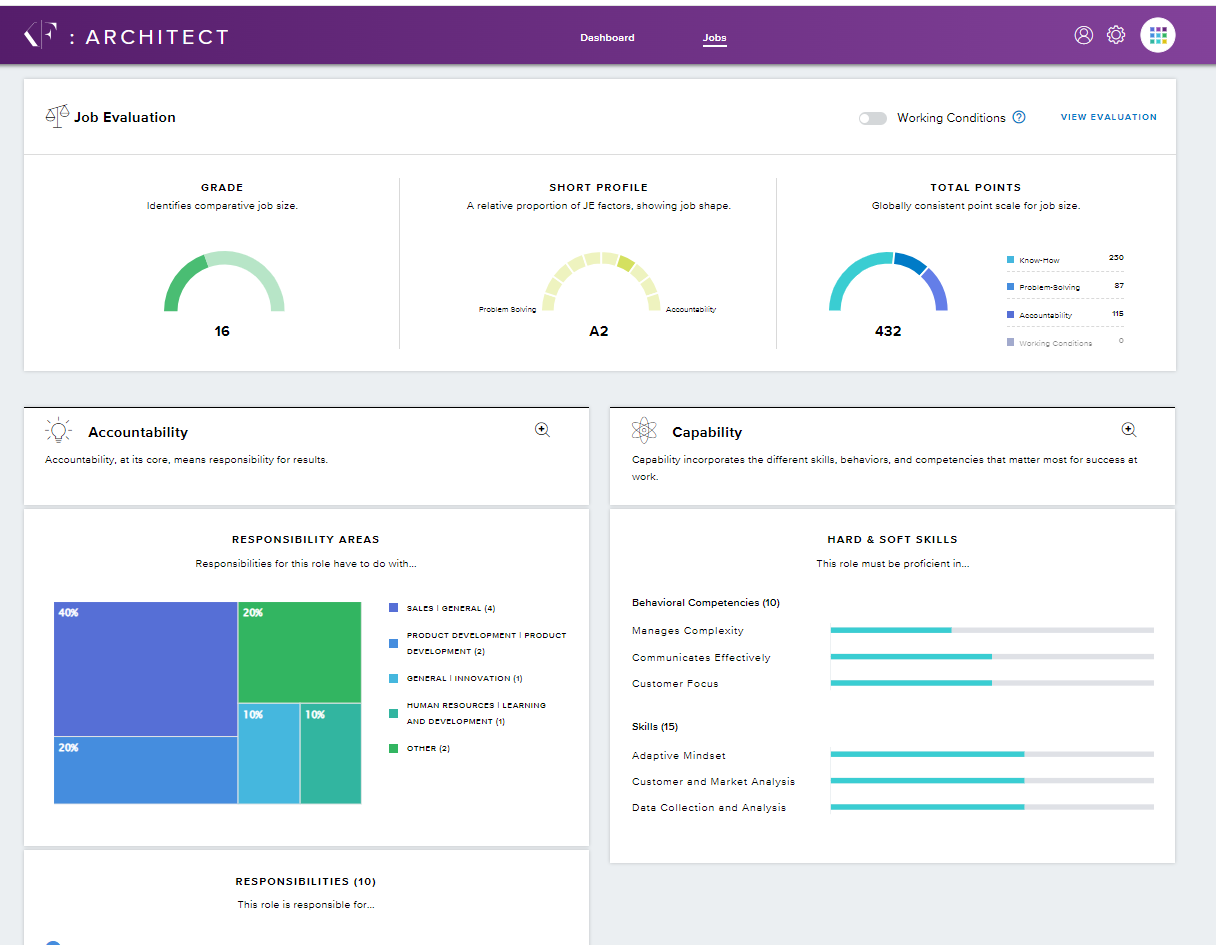
The most globally recognised job evaluation methodology - The Korn Ferry / Hay methodology is the most widely recognised job evaluation framework in the world, with decades of adoption across large and complex organisations in multiple sectors and geographies. Its outputs carry credibility with senior stakeholders, boards and legal advisors alike.
Court-tested track record - The Hay methodology has been tested and upheld in employment tribunal and equal pay litigation contexts. For organisations in heavily regulated or legally complex environments, this is a meaningful consideration.
Integration across talent and reward processes - As part of the Intelligence Cloud, job evaluation connects to career frameworks, pay structures, benchmarking data and broader talent processes, enabling wider use beyond a standalone evaluation exercise.
Strong market credibility - Korn Ferry's reputation and track record with global organisations can ease internal approval processes and provide confidence in the rigour of the approach.
Korn Ferry Architect cons
Consultancy-led with significant cost and timeline overhead - Korn Ferry's core offering is consultancy and job evaluation projects can be time-consuming and expensive, often taking months and requiring substantial internal input. Organisations looking for a faster, more self-serve approach are likely to find the model misaligned with their needs.
Methodology complexity creates ongoing dependency - The Hay methodology is highly complex. Korn Ferry offers a multi-day paid training course that covers only mid-level evaluation. This makes consistent in-house application difficult and creates ongoing reliance on Korn Ferry for changes, calibration and updates.
A methodology designed in the 1950s - The Hay methodology was developed in the 1950s and, while incrementally updated, remains anchored in assumptions about how organisations are structured and how work is performed that predate the modern economy. In an era of cross-functional teams, fluid roles and skills-based work, a framework built around traditional hierarchies and factor scoring is an increasingly awkward fit.
Geometric progression overstates senior differentiation - The Hay methodology uses a geometric point scale, meaning the difference in points between senior grades is disproportionately large compared to junior grades. In practice this can overstate the perceived gap between executive and mid-level roles and make the framework harder to explain to employees and managers who question why the numbers look the way they do.
Strong public sector orientation - The Hay methodology has historically been most widely adopted in public sector and large hierarchical organisations. It may be less well suited to technology companies, scale-ups or organisations with more fluid, skills-based structures.
Point-factor subjectivity without transparency — The Hay methodology relies on assigning values to evaluation factors, a process that introduces subjectivity depending on who is conducting the evaluation. The scoring logic and weighting are not readily visible to the client organisation, making it difficult to explain or evidence individual evaluation decisions to employees or regulators, a meaningful limitation under the EU Pay Transparency Directive.
Aon is a global professional services firm providing solutions across talent, rewards and human capital strategy. Its job evaluation offering is consulting-led, drawing on Aon's market data, methodologies and proprietary tools, including JobLink, to support role alignment and grading within a structured framework.
Aon does not offer a standalone, productised job evaluation platform. Instead, it works with organisations on a project basis to design and implement evaluation frameworks, using its compensation data as a foundation. The resulting framework supports broader processes including career development, pay structures and workforce planning.
Key features
Data-informed approach with strong market alignment - Aon's evaluation methodology is underpinned by its compensation survey data, helping organisations design frameworks that reflect both internal equity and external market positioning from the outset.
Flexible and customisable design - Aon's approach can be adapted to reflect each organisation's specific structure and context, rather than applying a rigid fixed model.
Linkage to broader reward strategy - Job evaluation is positioned as a foundation for wider processes including pay transparency, workforce planning and career development, supporting alignment between HR strategy and business goals.
Aon job evaluation cons
Consulting-led model limits self-serve governance - While Aon offers JobLink as a platform for role alignment and evaluation, the model remains primarily consulting-led. Ongoing updates, recalibrations and governance depend on re-engaging Aon rather than managing the framework independently, which means consistency is difficult to maintain and the framework can quietly drift over time.
Dependency on Aon data and methodology - The approach is closely tied to Aon's frameworks and Radford McLagan datasets. Organisations wanting independence from a specific provider's commercial model may find this creates long-term dependency.
Time and resource intensive - A consulting-led implementation requires significant time and internal stakeholder input, with higher upfront costs than SaaS alternatives. Ongoing updates are likely to require re-engagement with Aon rather than self-serve platform management.
No explicit factor scores or rationale trail - Aon's approach is levelling-led with implicit evaluation factors rather than explicit point-factor scoring. In practice this means there are no documented factor scores or structured rationale trail behind individual levelling decisions. For organisations that need to demonstrate the objective basis of pay decisions under the EU Pay Transparency Directive, the absence of an auditable evaluation record is a significant gap.
Less suited to continuous in-platform governance - Aon's model is designed around project implementation and advisory rather than day-to-day in-platform management. Once the initialframework is in place, ongoing updates and governance depend on process rather than platform — which means consistency is difficult to maintain and the framework can quietly drift over time.
Willis Towers Watson (WTW) is a global advisory firm providing services across reward, talent and workforce strategy. Its job levelling and evaluation capability centres on the Global Grading System (GGS), a points-based methodology that assesses roles against universally applicable factors to determine internal job levels. GGS supports up to 25 grades structured across banding and grading steps, accommodating both individual contributor and management career paths.
Key features
Established and globally recognised methodology - GGS is a well-tested methodology with broad adoption across large, complex organisations worldwide. Its structured approach to grading and its alignment with WTW's compensation surveys make it a credible foundation for organisations seeking an established framework.
Flexibility across methodology and deployment - GGS and Career Map can be used independently, in combination, or adapted as a baseline for bespoke approaches — giving organisations more design flexibility than some traditional frameworks.
Strong compensation survey alignment - GGS grades align directly to WTW's compensation surveys, providing a strong foundation for market benchmarking and pay decisions grounded in external data.
Broad organisational applicability - GGS is designed to apply across organisations of any size, industry and geography, making it well suited to complex, multi-region environments.
WTW GGS cons
Primarily consulting-led - WTW's offering is primarily delivered through consulting engagements. Organisations looking for a fully self-serve in-platform management experience for ongoing levelling governance will find the model less suited to that need.
Black-box scoring with limited audit trail - GGS scoring is not transparent to the end user. Factor scores and the rationale behind individual levelling outcomes are not readily visible within the platform, making it difficult for organisations to explain or evidence evaluation decisions to employees or regulators. This is a meaningful limitation under the EU Pay Transparency Directive, which requires documented, objective justification for pay decisions.
Complex grade structure hard to communicate - GGS supports up to 25 grades, which creates significant complexity in communicating levels clearly to managers and employees. Differentiating meaningfully between adjacent grades and explaining those differences in plain language could be a challenge for organisations using the framework.
Outdated user experience with restrictive access controls - The GGS platform UX is widely perceived as dated compared to modern HR software. A further practical frustration is that managers cannot view job evaluation data without also being granted editing rights, which creates a governance and access control problem for organisations that want to give managers visibility without the ability to change outcomes.
Methodology dependency and long-term reliance - As with other consultancy-led frameworks, the structure is closely tied to WTW's proprietary methodology. Organisations seeking independence from a provider's commercial model will find that dependency is structural rather than optional.
Premium pricing - WTW's market position and focus on large global organisations is reflected in its pricing, making it a less cost-efficient option than dedicated software platforms for organisations that do not require the full weight of a WTW consulting engagement.
AI-automated levelling raises governance concerns - WTW offers AI-Automated Job Levelling (AJL) for bulk role evaluation. While this addresses the scale challenge, AI-driven bulk evaluation without human oversight raises meaningful governance questions for pay-related decisions, particularly where auditability and consistency of outcome are required.
Gradar is a job architecture and job evaluation platform that uses a point-factor methodology to evaluate roles and build a structured levelling framework. Roles are assessed against standardised factors across three career tracks - individual contributor, management and project management - producing a scored output that determines job level. The result is a framework with up to 25 levels, defined career tracks and the ability to integrate third-party benchmarking data for pay equity analysis.
Gradar is designed to give organisations a self-serve, software-driven alternative to consultant-led evaluation, and consistently receives positive reviews for ease of use and customer support.
Key features
User-friendly with excellent customer support - Gradar receives positive reviews for its ease of use and the quality of its customer support team. This makes it accessible to HR teams without deep job evaluation expertise and reduces the friction of getting started.
Self-serve without consultant dependency - Gradar provides a software-driven approach that organisations can operate independently, avoiding the cost and timeline overhead associated with consulting-led implementations.
Integrated evaluation and job architecture - By combining job evaluation with job architecture design, Gradar enables organisations to build a structured levelling framework directly from role assessments rather than managing the two processes separately.
Gradar cons
Not perceived as enterprise-grade - Gradar is well suited to smaller and mid-market organisations, but it is not widely adopted at enterprise scale. Organisations with complex, global job structures or high governance requirements may find the platform's depth and configurability falls short of what they need.
Governance and calibration tools are more limited than dedicated compliance platforms - While Gradar provides an audit trail for individual evaluation decisions, its governance and calibration capability is more limited than platforms built specifically for compliance-grade evaluation. Organisations with complex structures or high regulatory scrutiny may want to verify that the depth of documentation meets their requirements under the EU Pay Transparency Directive.
Point-factor methodology carries inherent subjectivity - The point-factor method relies on assigning values to evaluation factors, a process that introduces variability depending on who is conducting the evaluation. Without strong decision-support and calibration tools, this subjectivity can quietly undermine the consistency the framework is supposed to create.
25-level structure adds complexity - A framework with up to 25 levels can make it difficult to differentiate clearly between adjacent grades and may create confusion for managers and employees trying to understand career progression.
Non-standard project management career track - The inclusion of a separate project management career track is not how most organisations structure their levelling frameworks, which may require workarounds or adaptation for teams that do not operate this way.
No proprietary benchmarking data - Gradar does not own compensation data. Organisations must either import data from a third-party provider or purchase it through Gradar as a reseller, which can reduce the reliability and integration quality of benchmarking compared to platforms with proprietary datasets.
Ravio is a compensation management platform that embeds job levelling as a core foundation for benchmarking, pay equity analysis and salary banding. Rather than offering job evaluation as a standalone module, Ravio applies a standardised, pre-defined levelling framework to all new customers as part of onboarding, mapping employees to a consistent set of levels, career tracks and progression pathways that are directly aligned to its real-time benchmarking dataset.
For organisations without an existing levelling framework, Ravio's team evaluates employees individually and assigns appropriate levels. For those with an existing framework, a bespoke correlation table is produced to align internal levels to Ravio's model.
Key features
Levelling done for you as part of onboarding - Ravio removes the overhead of designing and implementing a levelling framework by applying a best-practice structure as the first step of joining the platform. For organisations without an existing approach, this provides immediate value without significant internal effort.
Direct and immediate alignment with benchmarking data - Because Ravio's levelling framework is directly connected to its compensation benchmarking dataset, organisations benefit from like-for-like market comparisons from day one.
Scalable and straightforward framework - The Ravio framework is designed to work across organisations of different sizes and structures, with clear level definitions and career tracks that scale as companies grow.
Ravio cons
Not a standalone job evaluation platform - Levelling in Ravio is embedded within its broader compensation management platform. Organisations looking for a dedicated evaluation tool with calibration workflows, governance controls and audit capability independent of compensation workflows may find the model does not meet their requirements.
Standardised framework limits flexibility - Ravio's approach is based on a pre-defined structure. Organisations with highly bespoke job architectures or strong preferences for their own methodology may find the standardised model difficult to adapt to their specific context.
No calibration workflows or governance controls - Ravio does not provide calibration workflows or structured governance controls for levelling decisions. There is no mechanism for managing evaluation consistency across managers, functions or geographies and no audit trail of how or why individual levelling decisions were made. For organisations that need to evidence the basis of pay decisions under the EU Pay Transparency Directive, this is a critical limitation.
Dependency on Ravio's model for full platform value - To benefit fully from Ravio's benchmarking and pay equity features, organisations need to align their roles to the Ravio framework which may require meaningful rework of existing internal role structures.
Levelling derived from market data rather than objective evaluation - Because Ravio’s framework is grounded in compensation benchmarking, it inherits existing market rates rather than correcting them, the opposite of what the EU Pay Transparency Directive requires.
Pave is a compensation management platform that uses AI-powered job matching and machine learning to help organisations level roles, build pay ranges and benchmark compensation against a real-time dataset drawn from over 8,700 companies. Job levelling in Pave is embedded within the platform's broader compensation workflow, with roles mapped to a standardised level framework as part of market pricing and benchmarking.
Key features
AI-powered levelling at scale - Pave's machine learning approach enables organisations to level large volumes of roles quickly and consistently, significantly reducing the manual effort typically associated with levelling projects.
Strong real-time benchmarking integration - Because Pave owns and maintains its own compensation dataset, levelling and benchmarking are tightly connected, ensuring level classifications translate directly into accurate, current market comparisons.
End-to-end compensation management - Pave connects levelling to pay ranges, merit cycles, equity planning and total rewards communication in a single platform.
Pave cons
Levelling is a component, not a dedicated discipline - Job levelling in Pave is a feature within a broader compensation platform rather than a specialist evaluation tool. Organisations seeking calibration workflows, a formal evaluation methodology, governance controls and an audit trail may find the depth of functionality insufficient.
Standardised catalogue may not fit complex structures - Pave's framework is built around its own job catalogue. Organisations with complex, non-standard role structures may need significant effort to align their existing taxonomy to Pave's model.
Primarily US-market focused - Pave's benchmarking data and platform design has historically been stronger for US-based organisations. Coverage and depth for European and other international markets may be more limited.
Not designed for EU Pay Transparency governance - Pave does not appear to have been specifically designed to meet the documentation, audit trail and governance requirements of the EU Pay Transparency Directive, which may limit its suitability for organisations with significant European operations.
Levelling derived from market data rather than objective evaluation - Because Pave’s levelling is built on its benchmarking dataset, it reflects existing market rates rather than an independent assessment of role value, a structural limitation under the EU Pay Transparency Directive.
Lattice is a people management platform providing tools across performance management, employee engagement, career development and compensation. Its job levelling capability sits within Lattice Grow, a module focused on career frameworks, competency matrices and progression pathways.
Job levelling in Lattice is designed around career development and employee experience rather than formal job evaluation or pay governance. It enables organisations to build and communicate levelling frameworks but does not provide a structured evaluation methodology, audit capability or the pay transparency governance features needed for regulatory compliance.
Key features
Strong employee-facing career development experience - Lattice's levelling framework is designed to be visible and accessible to employees, helping them understand what progression looks like and what is expected at each level. This supports engagement, retention and more transparent career conversations.
Connected to performance and development - Levels and competencies connect directly to performance reviews, feedback cycles and development plans, embedding levelling into day-to-day people management.
Flexible framework customisation - Lattice provides pre-loaded track templates with competencies and levels that can be customised to align with an organisation's own framework.
Lattice cons
Not a job evaluation tool - Lattice does not provide a structured job evaluation methodology. There is no point-factor or scoring approach, no formal evaluation process, no calibration workflow and no audit trail.
Career framework tool rather than evaluation governance platform - Lattice Grow is designed to communicate career pathways rather than govern evaluation decisions. It lacks the version control, formal governance and audit features needed to manage job evaluation as a compliant and defensible process.
Levelling is not the primary focus - Lattice is primarily a performance management and engagement platform. Job levelling is one component of a broad product suite, which means depth and rigour may not meet the needs of organisations with complex or compliance-driven requirements.
Not suitable for EU Pay Transparency compliance - Without a formal evaluation methodology, scientific foundations, calibration workflows or governance audit capability, Lattice cannot provide the evidential foundation required to demonstrate compliance with the EU Pay Transparency Directive. Organisations relying on Lattice career tracks as a substitute for a formal job evaluation process are likely to face significant gaps when regulators or employees ask for the objective basis of pay decisions.
Colmeia is a cloud-based job architecture platform designed to help organisations build, manage and maintain structured job data across roles, skills and levels at global scale. It provides a centralised Global Job Catalog with AI-powered content generation, job mapping and multi-language support, positioned for organisations managing complex, global job structures.
Job levelling and grading in Colmeia is embedded within the broader job architecture and catalogue management workflow, enabling organisations to standardise grades and levels across functions and regions.
Key features
Centralised global job architecture and grading - Colmeia provides a single system for managing job profiles, skills and grades across teams, functions and regions at scale, helping multinational organisations maintain consistency.
AI-supported content creation reduces manual effort - The use of AI to generate and standardise job content reduces the manual overhead required to build and maintain a large job catalogue.
Supports compliance and transparency - Standardised grading and job structures provide a more consistent foundation for pay decisions, supporting organisations working towards pay transparency and regulatory compliance.
Colmeia cons
No formal job evaluation methodology - Colmeia manages grading and job architecture within the platform but does not provide a structured, scored evaluation methodology. There is no point-factor scoring, no calibration mechanism and no audit trail of evaluation decisions. Organisations that need to demonstrate a gender-neutral, objective basis for pay decisions under the EU Pay Transparency Directive will find that Colmeia's grading capability does not meet that evidential standard.
Complex to onboard for new users - The platform's advanced capabilities can require meaningful time and training for teams unfamiliar with structured job architecture approaches, which may slow initial adoption.
Better suited to large, global organisations - Colmeia is designed for complex, global environments and may offer more than is needed for smaller organisations with simpler job structures.
Requires significant upfront data preparation - Moving from unstructured job data to a centralised architecture requires meaningful initial effort to clean, standardise and align data before the platform delivers its full value.
Sysarb is a cloud-based pay transparency platform with strong roots in the Scandinavian market and growing adoption across Europe. Its offering covers job evaluation, job architecture, pay range design, gender pay gap analysis, compliance reporting and employee-facing pay transparency tools in a single integrated platform, with a particular focus on EU Pay Transparency Directive compliance.
Key features
Broad EUPTD coverage in a single platform - Sysarb covers job evaluation, pay equity analysis and compliance reporting without requiring multiple tools or manual data consolidation, making it one of the more complete options for organisations focused on EU Pay Transparency compliance.
Strong European compliance focus - Built for the European regulatory environment, with particular depth in gender pay gap reporting and the documentation requirements of the Directive.
Sysarb cons
Methodology transparency is limited - Sysarb's website does not publish detail on the factor design or scoring logic underpinning its job evaluation module. Organisations that need to demonstrate a documented, objective evidential chain for individual evaluation decisions may want to verify this capability before committing.
Strongest adoption in Scandinavia - Sysarb's most established customer base is in Sweden and the broader Nordic region. Organisations outside Scandinavia should assess the depth of local support and implementation experience in their market.
No visible connection to job description content, skills or broader job architecture - The platform does not appear to integrate job evaluation with wider job data in the way that purpose-built job architecture platforms do.
TurningPoint is a UK-based pay and reward consultancy offering job evaluation through OrbitEval, a cloud-based configurable points-based system using 15 discrete factors, alongside salary benchmarking and organisational charting tools within its broader Orbit suite. The offering combines software with consultancy support and is positioned as an accessible, affordable solution for UK organisations.
Key features
Accessible and affordable for UK organisations - The Orbit suite is designed to be intuitive and cost-effective, combining job evaluation with benchmarking and org charting in a single platform. Customer reviews consistently highlight ease of use and quality of support.
Configurable methodology - OrbitEval can be adapted to reflect an organisation's culture and values rather than applying a rigid fixed model, with factors and descriptions configured to the organisation's context.
TurningPoint cons
Primarily UK-focused - TurningPoint's client base, benchmarking data and compliance focus are largely UK-centric. Organisations with significant international operations should assess whether the platform's depth and coverage meet their needs outside the UK.
Combined consultancy and software model - TurningPoint's approach blends software with consultancy support, which may limit fully independent self-serve governance for organisations that want to manage evaluation entirely in-house.
Factor design rationale not published - OrbitEval uses 15 discrete factors but does not appear to publish the rationale for factor selection or weighting design. Organisations that need to evidence the objective basis of their evaluation methodology under the EU Pay Transparency Directive may find this a gap.
No connection to job description content, skills or HCM ecosystem - OrbitEval sits in isolation from broader job architecture and skills data, with no visible integration with major HRIS platforms. Levelling outcomes do not flow through to role profiles or connected systems.
No visible EUPTD-specific design - TurningPoint's compliance focus is the UK Equality Act 2010. There is no visible evidence that the platform has been designed to meet the specific documentation, audit trail and governance requirements of the EU Pay Transparency Directive.
Building job levelling and evaluation in-house
Many organisations begin by attempting to build a levelling framework internally, typically in spreadsheets or Word documents. This can appear cost-effective initially and offers a high degree of control over design. In practice, however, building and maintaining a robust and defensible levelling framework in-house is one of the most resource-intensive HR initiatives organisations undertake and also one of the most frequently stalled.
Full control over design and structure - Building in-house allows organisations to design a levelling framework that directly reflects their operating model, culture and ways of working, without needing to adapt to an external methodology or commercial product.
Leverages internal expertise - Subject matter experts and managers can contribute directly to defining what each level requires, helping ensure the framework reflects how work is actually performed across the business.
No upfront software or consultancy cost - A DIY approach avoids the immediate investment in external tools or services, which can be appealing when budgets are under pressure.
DIY cons
Highly manual and time-intensive - Designing a levelling framework from scratch requires significant input from HR, Reward and business stakeholders. In larger organisations, this typically takes many months to complete and frequently stalls before delivery as other priorities take over.
Consistency is very hard to achieve and maintain - Without a structured methodology and centralised system, similar roles are often levelled differently across teams, managers and geographies creating exactly the inconsistencies that a levelling framework is supposed to prevent.
Not defensible under scrutiny - Spreadsheet-based frameworks typically lack the documented rationale, structured methodology and audit trail needed to demonstrate compliance with pay transparency requirements or to defend levelling decisions in response to employee challenge or regulatory inquiry.
Hard to maintain as the organisation evolves - Job levelling is not a one-off project. Frameworks built in documents quickly become outdated as roles change, new teams form and organisations restructure and updating them consistently at scale without a governed platform is extremely difficult.
High hidden cost in time and resource - While there may be no upfront technology cost, the internal effort required is substantial. For larger organisations, this can equate to hundreds or thousands of hours of HR and business time often without producing a framework that is truly fit for purpose.
Not defensible under EU Pay Transparency - The EU Pay Transparency Directive requires organisations to demonstrate that pay decisions are grounded in objective, gender-neutral evaluation criteria. A spreadsheet-based or informally constructed in-house framework will rarely provide the evidential foundation or governance standard this requires and using market pricing alone as the basis for pay decisions does not constitute a valid gender-neutral job evaluation methodology under the Directive.
The consultant retainer trap - Some organisations build an in-house framework but retain an external consultant to support ongoing evaluation decisions. This solves the methodologyproblem partially but creates a different one: knowledge sits outside the organisation, costs recur every time a decision needs to be made, and the framework stalls when the consultant relationship ends or the internal project owner moves on.
In-house AI builds are fast but not compliant - A growing number of organisations are attempting to build evaluation tools using internal AI capability or off-the-shelf AI agents. These approaches can be fast and flexible but they are not consistent, not auditable and not designed to meet the governance and evidential standards of the EU Pay Transparency Directive. Speed of build is not the same as fitness for purpose.
The single point of failure problem - In many organisations, the entire levelling framework exists in one person's head. When that person leaves — and they will — consistency collapses, decisions become harder to explain and the organisation is back to square one. A governed platform removes this risk by embedding the methodology, the decisions and the audit trail in the system rather than in an individual.
In 45 minutes you'll have a clear picture of what RoleMapper can do for your organisation.
See it in action
A live walkthrough of the Job Architecture Data Transformation Service using real-world examples.
Understand the outputs
See the job profiles, job descriptions and architecture structures we deliver and how they connect to your wider people strategy.
Get a clear next step
Leave with a practical view of what a project would look like for your organisation, timeline and all.
Trusted by global enterprises. Response within 24 hours.