

Talk to our team
Speak to a specialist about a guided engagement for your organisation.
Talk to our teamSee how it worksFrom the hub
Guides, webinars and research to help you build better job architecture
Browse all resourcesSubscribe for updatesSpeak to a specialist about a guided engagement for your organisation.
Talk to our teamSee how it worksGuides, webinars and research to help you build better job architecture
Browse all resourcesSubscribe for updatesWe’ve reviewed the market, including both consultancies with software-enabled solutions and dedicated job architecture platforms, comparing capabilities, strengths and limitations.
RoleMapper is a job architecture platform designed to help organisations create, manage and maintain structured job data across roles, skills and levels, as a connected, living system rather than static documents.
At the core of the solution is RoleMapper’s Data Transformation Service (DTS) — a proprietary approach that combines advanced AI with human expertise to rapidly transform fragmented job data into a clean, consistent and future-fit job architecture.
Using DTS, organisations can standardise job titles, descriptions, skills, proficiency levels and job levels, typically in under 12 weeks. This creates a robust, level-aligned architecture that reflects how work is actually performed and can scale as organisations evolve.
This is supported by RoleArchitect, the platform that enables organisations to manage job architecture as structured, connected data linking job structures, titles (including variations), role profiles, skills and level definitions in a single, governed environment.
Key features
Fast, high-quality architecture creation
RoleMapper’s Data Transformation Service (DTS) can work as a standalone solution for creating or enhancing your job architecture, combining proprietary AI with expert input to transform fragmented job data into a consistent, organisation-wide structure in weeks rather than months.
Adaptable, ready-built foundation
RoleMapper includes pre-built job architecture structures and role profile libraries that can be tailored to reflect organisational design, terminology and ways of working, avoiding the need to build from scratch.
Deep, multi-dimensional role design
The platform connects jobs, work, skills and proficiency levels in a single framework, with the ability to go deep into role profiles and position-level detail, ensuring accuracy and practical usability.
Clear, scalable levelling frameworks
Built-in levelling structures aligned to skills and responsibilities enable consistent application across functions, supporting career pathways, reward and organisational design.
Dynamic, connected data model
RoleMapper links job structures, titles, role profiles, job descriptions and levels into a single, integrated system — ensuring changes flow through consistently and eliminating duplication.
Ongoing governance and ease of maintenance
A single platform with workflows, approvals and version control supports continuous updates, making it easier to maintain accuracy without fragmented processes or multiple systems.
Access to robust job and market data
RoleMapper provides access to structured job catalogues and continuously improving datasets, helping organisations benchmark and maintain external relevance.
Seamless integration with HR systems
Integration with HRIS platforms as Workday ensures job architecture is embedded across reward, talent and workforce planning processes, rather than sitting separately.
Secure and compliant by design
Strong data security standards and clear AI governance ensure compliance with data protection requirements and responsible use of technology.
RoleMapper Job Architecture Cons
Not designed as a standalone job description management or job evaluation tool
If you are looking for a simple job description management solution or a standalone job evaluation tool, RoleMapper may be more advanced than required.
Best suited to larger, more complex organisations
RoleMapper is designed for enterprise environments. Organisations with fewer than 100 employees may find the platform more than they need.
Mercer is a global consultancy providing a wide range of HR and reward services, including job architecture, job evaluation and compensation benchmarking.
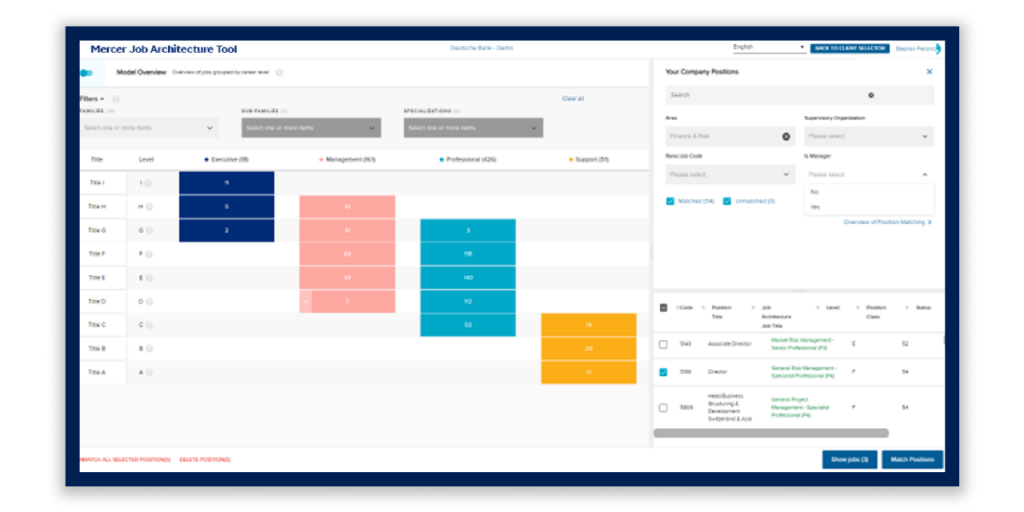
As part of its offering, Mercer provides the Job Architecture Tool (JAT), a web-based platform designed to support organisations in building and managing job architecture structures.
Mercer typically works with organisations on a project basis to design and implement a job architecture, using its established methodologies and frameworks. This includes defining job families, roles and levels, often aligned to Mercer’s broader approaches to job evaluation and career frameworks.
Once implemented, the job architecture can be accessed and managed within the Job Architecture Tool.
Key Features:
The tool is typically used alongside Mercer’s consulting services, which support the design, implementation and ongoing application of job architecture.
Mercer can also support organisations in using job architecture outputs to inform related processes such as career frameworks, pay structures and workforce planning.
Established methodology and consultancy support:
Mercer combines its technology with well-established frameworks and consulting expertise, supporting organisations through the design and implementation of job architecture and helping ensure consistency across roles and levels.
Flexible and configurable job architecture design:
The tool allows organisations to tailor job families, levels and structures to reflect their specific organisational model, rather than applying a fixed or pre-defined structure.
Centralised job architecture management:
JAT provides a single system to store and manage job architecture data, improving visibility and helping ensure that roles, levels and structures are applied consistently across the organisation.
Access to a large job library:
Organisations can leverage Mercer’s job content to support the development and standardisation of job structures, reducing the effort required to build job architecture from scratch.
Mercer Job Architecture Tool (JAT) cons
Framework-led approach may shape the design:
Job architecture is typically built using Mercer’s established methodologies and job library, which can influence how roles and levels are structured.
Primarily designed for structured implementation project:
The tool is often used as part of a defined rollout to support a consultancy project, which may be less suited to organisations looking for continuous, hands-on management of job architecture.
Higher cost associated with consultancy delivery:
Mercer typically works with large, global organisations and combines consulting with technology, which can result in higher overall project costs compared to standalone software solutions.
Premium pricing driven by brand and market position:
As a well-established consultancy with a strong reputation, Mercer is often perceived as a premium provider, and organisations should expect higher rates for implementation and ongoing support.
Limited visibility of day-to-day governance features:
There is limited publicly available detail on how workflows, approvals and ongoing updates are managed within the tool.
Korn Ferry is a global consultancy that supports organisations with talent strategy, organisational design and workforce transformation.
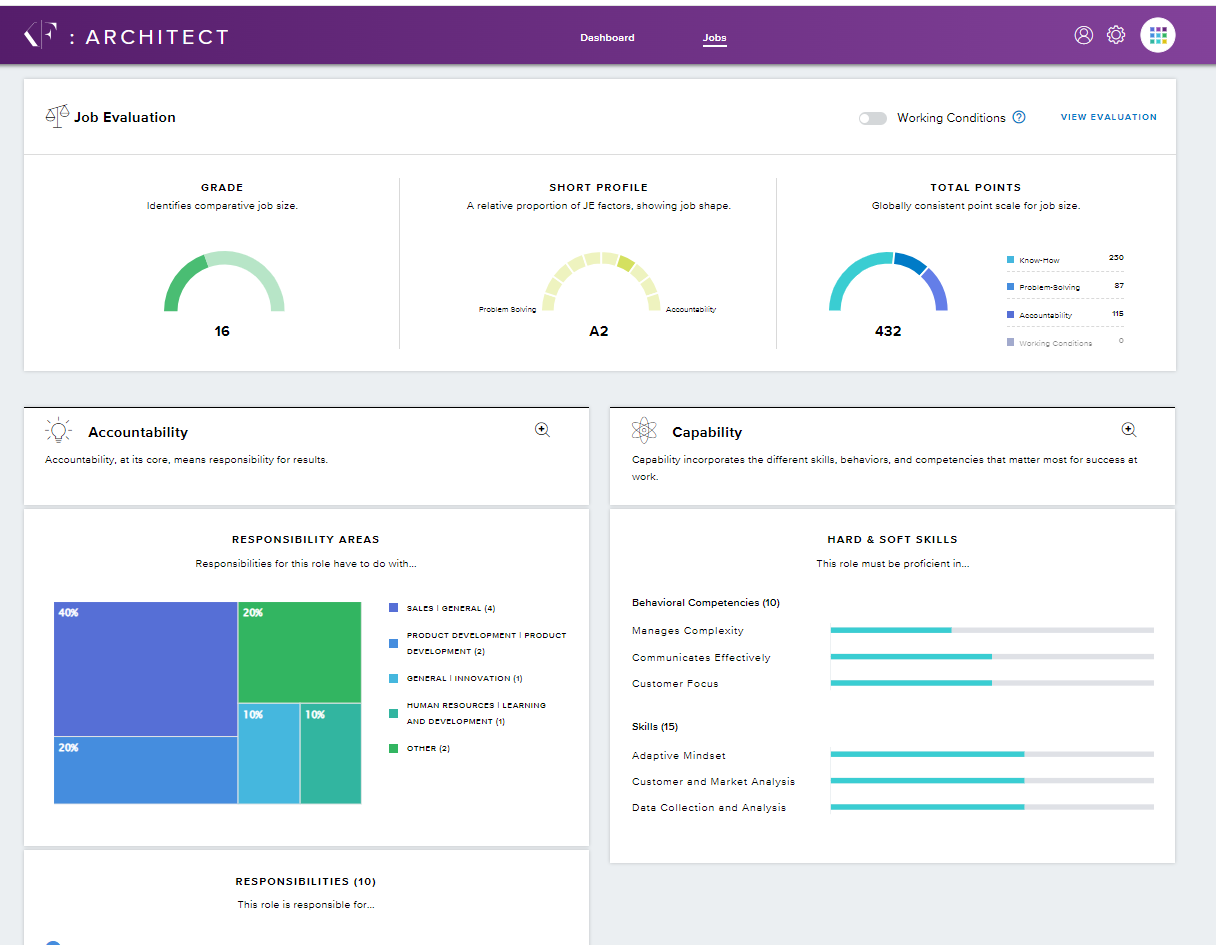
As part of its technology offering, Korn Ferry provides Korn Ferry Architect, a module within the Korn Ferry Intelligence Cloud designed to support job architecture and role design.
Korn Ferry typically works with organisations to design and implement job architecture using its established methodologies and frameworks. The resulting structure can then be accessed and managed within Korn Ferry Architect.
Key features:
The tool is typically used alongside Korn Ferry’s consulting services, which support the design and application of job architecture.
Established methodology and strong market credibility:
Korn Ferry has a long history of supporting organisations with job architecture and related processes, which gives their approach significant weight with senior stakeholders and can make it easier to gain internal buy-in.
Strong integration with talent processes:
As part of the Korn Ferry Intelligence Cloud, job architecture can be connected to career frameworks, pay structures and broader talent processes, enabling wider use across the organisation.
Access to extensive job content and frameworks:
The platform leverages Korn Ferry’s job library and intellectual property to support the creation of structured and consistent job architectures.
Korn Ferry Architect cons
Consultancy-led rather than software-first:
While Korn Ferry provides technology, its core offering is consultancy-led. Organisations looking for a more self-serve or software-driven approach to managing job architecture may find this less aligned to their needs.
Higher cost associated with premium consultancy providers:
Korn Ferry’s reputation and focus on large, global organisations typically results in higher project costs compared to standalone software solutions.
Time and resource intensive to implement:
Designing and implementing job architecture through a consultancy-led approach can take significant time, often requiring substantial input from internal teams.
Complex underlying frameworks:
The approach is based on established methodologies which can be complex to interpret and communicate internally, particularly for non-specialist users.
Closely tied to Korn Ferry frameworks and content:
The platform is built around Korn Ferry’s job architecture approach and job library, which may limit flexibility for organisations wanting a more independent or bespoke model.
More commonly used in structured or public sector environments:
Korn Ferry’s methodologies are widely used in large and structured organisations, including public sector environments, which may not always align with the needs of more flexible or rapidly changing organisations.
Aon is a global professional services firm providing solutions across talent, rewards and human capital strategy.
Aon does not offer a standalone, productised job architecture platform in the same way as some other providers. Instead, it delivers a consulting-led job architecture approach, supported by data, methodologies and proprietary tools such as JobLink.
Aon works with organisations to design and implement job architecture structures, focusing on defining job functions, families, roles and levels to create consistency and comparability across the organisation.
Key features:
Aon’s approach is typically delivered through consulting engagements, with tools used to support the process rather than acting as standalone platforms for ongoing management.
The resulting job architecture is intended to act as a foundation for broader people processes, including career frameworks, workforce planning and reward strategy.
Data-led approach supported by market insights:
Aon’s job architecture methodology is underpinned by its compensation and workforce data, helping organisations design structures that align with market practices and internal needs.
Flexible and customisable framework design:
Aon provides a structured approach that can be tailored to reflect each organisation’s specific structure, rather than applying a fixed model.
Strong linkage to broader people strategy:
Job architecture is designed to support wider processes such as pay transparency, workforce planning and career development, helping align HR and business strategy.
Aon Job Architecture cons
No standalone, productised job architecture platform: Aon's offering is primarily consulting-led, limiting self-service management, ongoing governance, and the ability to track adoption or demonstrate ROI compared to dedicated platforms with built-in dashboards and workflow features.
Dependent on Aon methodologies and data: The approach is closely tied to Aon's frameworks and Radford McLagan datasets, reducing flexibility for organisations wanting an independent model and creating potential long-term dependency on Aon's compensation data for ongoing market pricing.
Time and resource intensive to implement: A consultancy-led approach requires significant time, internal stakeholder input, and higher upfront costs compared to a SaaS model — with repeated re-engagement likely needed as the organisation evolves.
Less suited to ongoing, in-platform management: Designed around implementation and advisory rather than day-to-day use, ongoing updates rely on process over technology — and the model typically lacks the employee-facing career visibility or manager portals that purpose-built platforms provide.
Willis Towers Watson (WTW) is a global advisory firm providing services across rewards, talent and workforce strategy.
WTW does not offer a standalone, productised job architecture platform. Instead, it delivers a consulting-led job architecture and job levelling approach, supported by establishedmethodologies and software-enabled tools.
WTW works with organisations to design job architecture structures, focusing on defining job families, roles and levels to create a consistent framework for managing careers and rewards.
Key features:
WTW’s approach is typically delivered through consulting engagements, with tools used to support implementation rather than acting as standalone platforms for ongoing management.
The resulting job architecture is designed to act as a foundation for broader processes such as career development, workforce planning and reward strategy.
Established methodologies with strong market credibility:
WTW’s frameworks such as GGS and Career Map are widely used and recognised, helping organisations build job architecture aligned to established practices.
Flexible approach combining frameworks and customisation:
Organisations can use WTW’s predefined methodologies, combine them, or adapt them to create bespoke job architecture structures.
Integration with reward and career frameworks:
Job architecture is designed to support broader processes such as pay structures, career development and workforce planning.
WTW Job Architecture cons
No standalone, productised job architecture platform:
WTW’s offering is primarily consulting-led, with supporting tools rather than a dedicated software platform for ongoing management.
Dependent on WTW methodologies and frameworks:
The approach is closely tied to frameworks such as GGS and Career Map, which may limit flexibility for organisations wanting a fully independent model.
Time and resource intensive to implement:
As a consultancy-led approach, designing and implementing job architecture can require significant time and input from internal teams.
Less suited to continuous, system-based management:
The approach is designed around implementation and advisory, rather than day-to-day use within a dedicated platform for managing and updating job architecture.
Colmeia is a job architecture software platform designed to help organisations build, manage and maintain structured job data across roles, skills and levels.
The platform provides a dedicated, cloud-based system for job architecture.
Colmeia is designed to replace spreadsheets and fragmented job data with a structured, collaborative environment, enabling organisations to standardise job architecture at scale.
Key features:
The platform is particularly positioned for organisations managing complex, global job structures, including those undergoing restructuring or addressing compliance requirements.
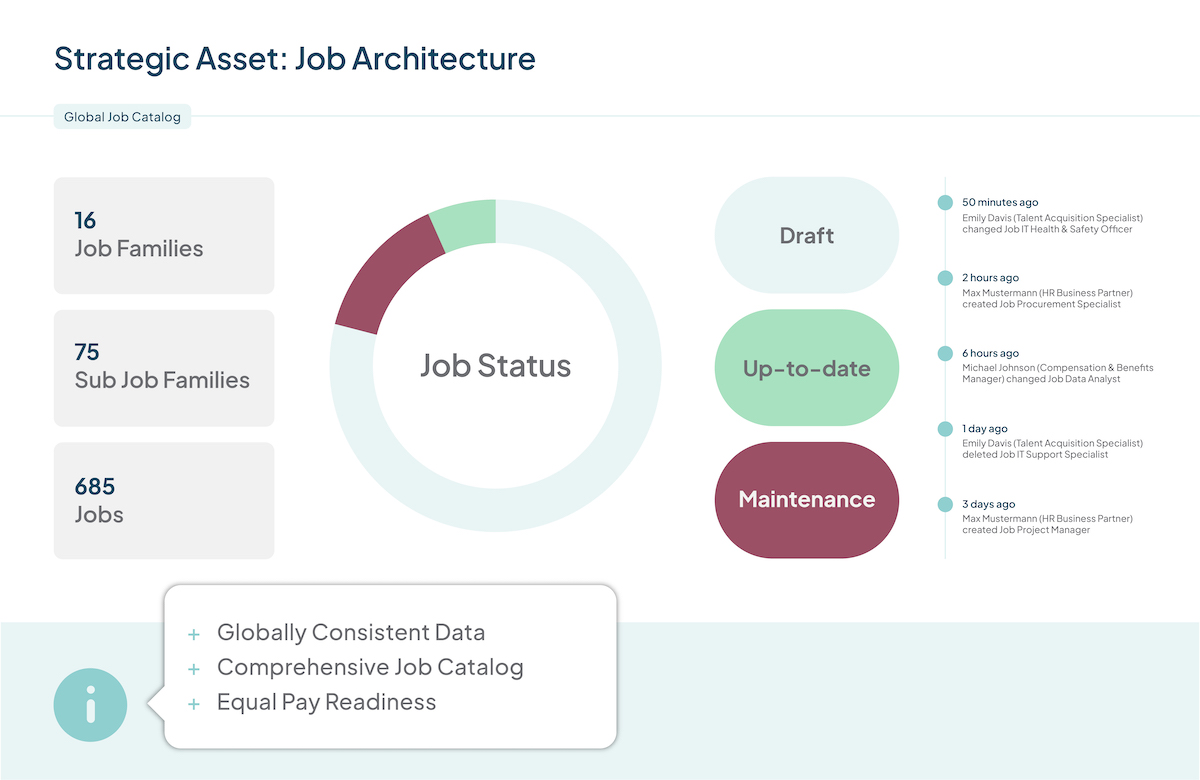
Centralised global job architecture:
Colmeia provides a single system to manage job profiles, skills and grading, helping organisations maintain consistency across teams, regions and functions.
AI-supported job content creation:
The platform uses AI to generate and standardise job descriptions, skills and competencies, reducing manual effort and improving consistency.
Improves compliance and transparency:
Standardised job structures and grading support more consistent decision-making and can help organisations meet regulatory and transparency requirements.
Integration with existing HR systems:
The platform integrates with key HR system enabling job architecture to connect with broader HR data.
Colmeia Job Architecture cons
Can be complex for new users:
The platform includes advanced capabilities, which may require time and training for teams unfamiliar with structured job architecture approaches.
Better suited to larger organisations:
Colmeia is designed for complex, global environments and may be less suitable for smaller organisations or those with simpler job structures.
Requires upfront data structuring:
Moving from unstructured job data to a centralised architecture requires initial effort to clean, standardise and align data.
Focused on job architecture scope:
Colmeia is a specialised platform and does not provide a full end-to-end HR or talent suite within a single product.
Sysarb is a pay transparency and job architecture platform designed to help organisations create, manage and maintain structured job data alongside pay equity and compliance processes.
The platform provides a cloud-based system for job architecture, positioned as part of a broader solution for managing pay transparency, job evaluation and compensation structures.
Sysarb enables organisations to define job architecture across roles, responsibilities and career paths, while connecting this to pay data and regulatory requirements.
Key features:
Sysarb is positioned as an integrated platform for pay transparency, combining job architecture with broader capabilities such as pay gap analysis, compliance reporting and compensation structuring.
Integrated job architecture and pay transparency platform:
Sysarb combines job architecture with pay equity analysis, job evaluation and compensation tools in a single system, reducing the need for multiple solutions.
Strong focus on compliance and regulation:
The platform is designed to support organisations in meeting regulatory requirements, including pay transparency and equal pay reporting, particularly in European markets.
Clear career path and progression design:
The platform helps organisations define and communicate career progression pathways based on structured job architecture
Sysarb Job Architecture cons
Job architecture is part of a broader pay transparency platform:
The product is designed as an integrated solution, which may be less suitable for organisations looking for a standalone, specialised job architecture tool.
Strong focus on European compliance requirements:
The platform is particularly aligned to EU pay transparency regulations, which may be less relevant for organisations operating outside these regulatory environments.
Limited depth in data analysis and reporting:
Some users report that data visibility can be limited, making it more difficult to analyse job and pay data in detail or across multiple dimensions.
Gaps in advanced analytical functionality:
Reviews highlight limitations when performing more granular analysis across roles, departments or categories.
Performance challenges during data setup:
Users have noted slower performance when uploading larger datasets, which can create friction during initial implementation.
Requires alignment between job architecture and pay data:
To realise full value, organisations need to integrate job architecture with compensation and workforce data, which can require additional setup and coordination.
Ravio is a compensation management platform that includes job architecture as a core foundation for benchmarking, pay equity and salary banding.
Rather than offering job architecture as a standalone module, Ravio embeds it into its onboarding and benchmarking workflow, providing organisations with a pre-defined, standardised job architecture framework.
Ravio’s approach centres around applying a consistent structure to roles, levels and career pathways, ensuring alignment between internal roles and external market data.
Key features:
Ravio’s job architecture is designed to be quick to implement and immediately usable, removing the need for organisations to build frameworks from scratch and ensuring alignment with market benchmarking data from day one.
Job architecture implemented as part of onboarding:
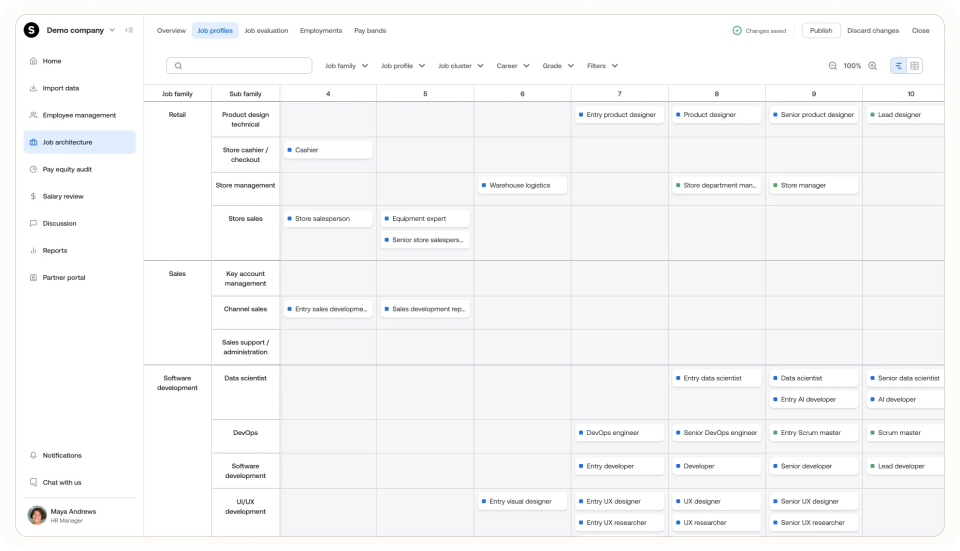
Ravio applies its job architecture framework during onboarding, mapping roles and employees to a consistent structure without requiring organisations to design one from scratch.
Standardised and scalable level framework:
The framework is designed to work across organisations of different sizes, providing clear levels, career tracks and progression pathways that scale as the company grows.
Strong alignment with benchmarking data:
Because job architecture is directly linked to Ravio’s benchmarking dataset, organisations can ensure like-for-like comparisons between internal roles and market data.
Ravio Job Architecture cons
Not a standalone job architecture platform:
Job architecture is embedded within Ravio’s broader compensation platform, which may be less suitable for organisations looking for a dedicated tool focused purely on job architecture design and governance.
Standardised framework may limit flexibility:
Ravio’s approach is based on applying a predefined structure, which may not fully reflect organisations with highly bespoke or complex job architectures.
Less emphasis on ongoing architecture governance:
The focus is on implementing a clear, consistent framework upfront, with less emphasis on providing a dedicated environment for continuous job architecture management and governance.
Dependent on Ravio’s model for alignment:
To fully benefit from benchmarking and pay features, organisations need to align their roles to Ravio’s framework, which may require adaptation from existing internal structures.
Gradar is a job architecture and job evaluation platform designed to help organisations build structured role frameworks, evaluate jobs and define career pathways.
The platform combines job evaluation with job architecture design, using a point-based factor methodology to assess roles and create a consistent structure of job levels and career tracks.
Gradar enables organisations to build a job architecture by evaluating roles against standardised factors, producing a structured framework of levels, responsibilities and progression pathways.
Key features:
Gradar’s approach is designed to create a ready-made job architecture, helping organisations move quickly from unstructured job data to a consistent and levelled framework.
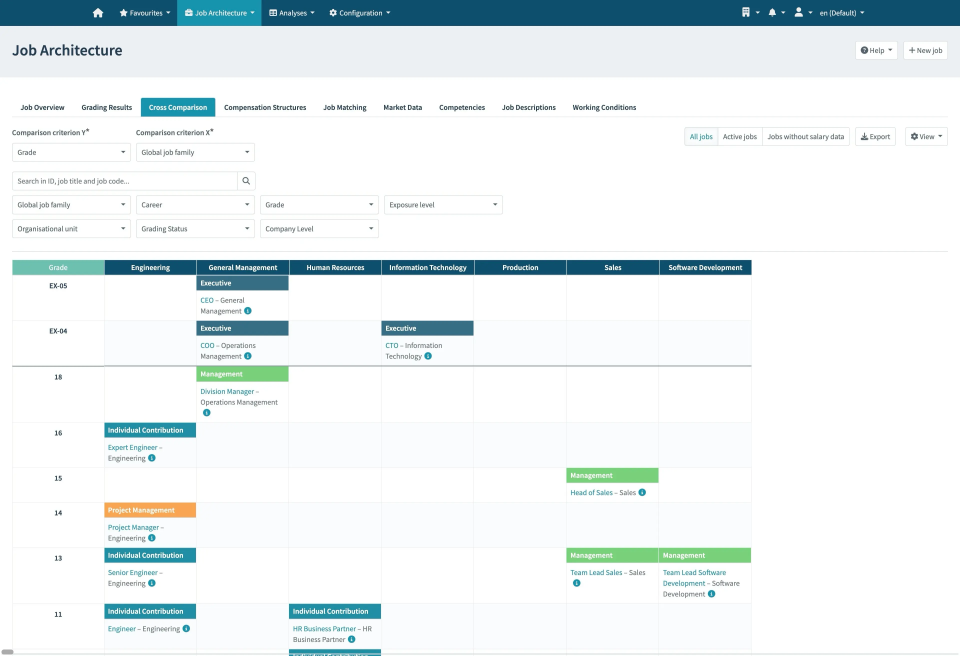
Structured and consistent job architecture framework:
Gradar creates a clearly defined job architecture with consistent levels and career tracks, helping organisations standardise roles and progression pathways.
Integrated job evaluation and architecture design:
By combining job evaluation with job architecture, Gradar enables organisations to build structured frameworks directly from role assessments.
Supports alignment with compensation data:
The platform allows organisations to integrate benchmarking data, helping align job architecture with pay structures and equity analysis.
Gradar Job Architecture cons
Complex level framework with many grades:
Gradar’s structure includes a large number of levels, which can make differentiation between roles less clear and introduce complexity in applying the framework.
Non-standard career track structure:
The inclusion of a separate project management track may not align with how all organisations structure roles, potentially requiring adaptation.
Dependent on point-based evaluation methodology:
The job architecture is built on a factor-based approach, which may limit flexibility compared to more open or data-driven models.
Potential for subjectivity in evaluation:
Although structured, the point-based method relies on assigning values to factors, which can introduce variability in how roles are assessed.
Relies on third-party benchmarking data:
Gradar does not own its own compensation datasets, requiring organisations to import or purchase external data to fully align job architecture with market benchmarks.
Many organisations initially consider building job architecture internally. This can be a practical starting point, particularly when there is a desire for full control over how roles, levels and skills are defined.
However, while a DIY approach can work at smaller scale, creating and maintaining a robust job architecture requires significant time, coordination and ongoing effort.
Full control over design and structure:
Building job architecture in-house allows organisations to define job families, levels and skills in a way that directly reflects their operating model and ways of working.
Ability to tailor to organisational context:
Internal teams can design frameworks that align closely with business needs, culture and existing processes, rather than adapting to an external methodology.
Leverages internal expertise:
Subject matter experts and managers contribute directly to defining roles and responsibilities, helping ensure the framework reflects how work is actually performed.
No upfront software or consultancy cost:
A DIY approach can appear more cost-effective initially, particularly for organisations looking to avoid investment in external tools or services.
DIY Job Atrchitecture cons
Highly manual and time-intensive:
Building job architecture internally is often a slow, resource-heavy process, requiring significant input from HR and business stakeholders. In larger organisations, this can take many months — and in some cases years — to complete.
Difficult to scale across the organisation:
Each role typically requires input from subject matter experts, making it challenging to scale consistently across hundreds or thousands of roles.
Challenges in achieving consistency:
Without a centralised approach or structured system, similar roles may be defined differently across teams, leading to inconsistencies in levels, responsibilities and skills.
Hard to maintain over time:
Job architecture is not a one-off exercise. Frameworks built in spreadsheets or static documents can quickly become outdated as roles evolve and organisations change.
Fragmented ownership and governance:
Responsibility for job architecture is often split across HR, Reward and business teams, making it difficult to maintain alignment and enforce standards.
Limited visibility and usability:
When stored in documents or spreadsheets, job architecture can be difficult to access, search and apply in day-to-day decisions such as hiring, pay or workforce planning.
Risk of incomplete delivery:
The scale of effort required means many DIY initiatives stall or are never fully completed, particularly as business priorities shift.
High hidden cost in time and resource:
While there may be no upfront technology cost, the internal effort required can be significant. For large organisations, this can equate to thousands of hours of HR and business time.
In 45 minutes you'll have a clear picture of what RoleMapper can do for your organisation.
See it in action
A live walkthrough of the Job Architecture Data Transformation Service using real-world examples.
Understand the outputs
See the job profiles, job descriptions and architecture structures we deliver and how they connect to your wider people strategy.
Get a clear next step
Leave with a practical view of what a project would look like for your organisation, timeline and all.
Trusted by global enterprises. Response within 24 hours.